(Caffinch) Downs
John and Mary
(Caffinch) Downs
John and Mary Downs were the first of the Downes/Downs Family to come to Connecticut. Records show that John Caffinch, John’s guardian (more on that later) is first seen in Guilford in 1639 with numerous others who emigrated from Kent, England. John Caffinch was said to remove from Guilford to New Haven shortly after that where we see his property in early maps of New Haven. Its almost certain that young John (being born around 1630, he would’ve been about 10 old) was with Caffinch as he went from Guilford to New Haven. Much more on John Caffinch and John Downs coming.
The Downe Family of Tenterden, Kent, England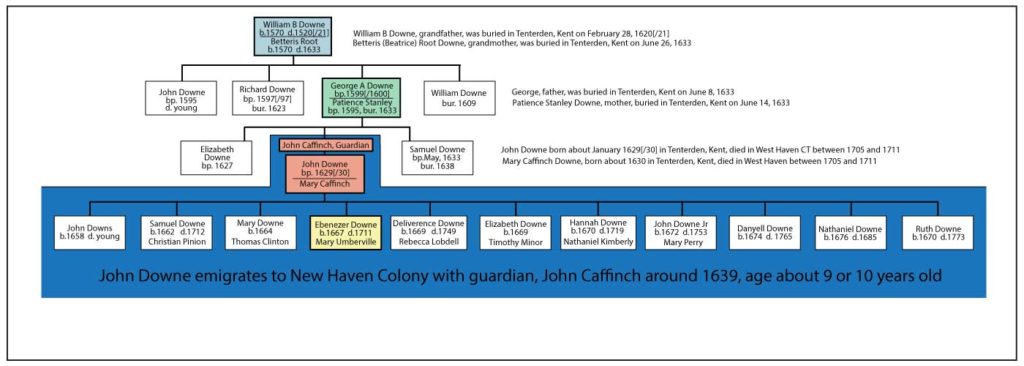
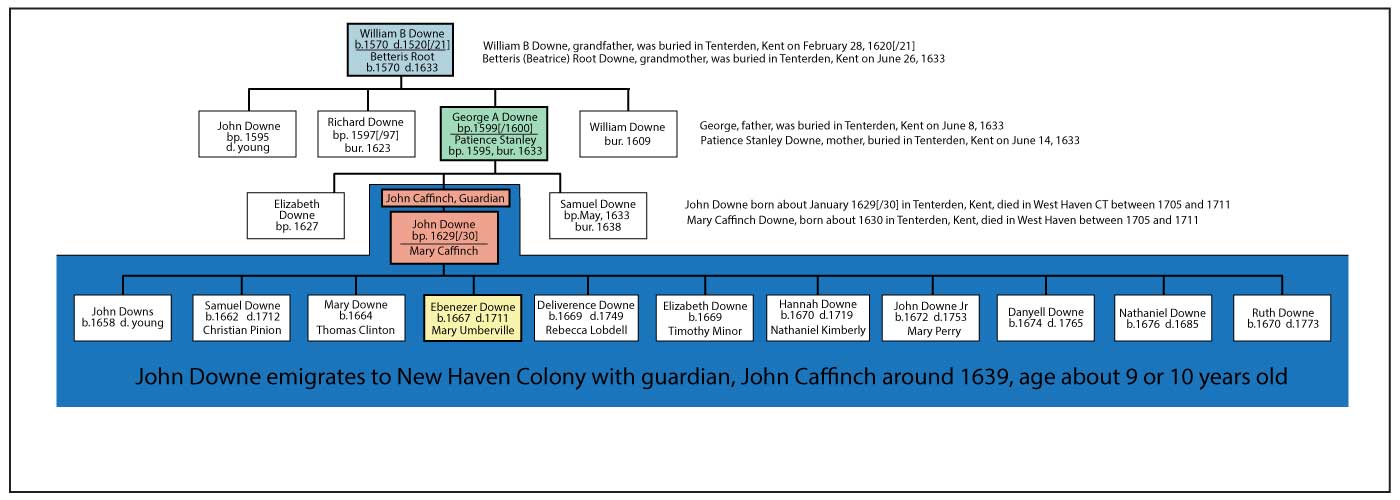
The Downs, or Downe, family lived in Tenterden, Kent in the southeast of England. In an article entitled “The English Ancestry of John Downe of New Haven, Connecticut: Nephew of the Stanleys of Hartford” (see Reference page), we know John’s grandfather, William Downe of Tenterden was likely born around 1570 (assuming he was about the same age as his wife, Betteris (Beatrice) Root, who was from nearby Cranbrook. They married in Tenterden in 1594. Both were buried in St Mildred’s Church burial yard in Tenterden. William died in February of 1620. William and Beatrice had four children: John Downe, born 1595 and probably died young, Richard Downe who was buried at St Mildreds on June 1, 1623 (Richard’s daughter Beatrice was born in 1622 and died and was buried at St. Mildreds in August of 1636), George Downe born around 1599[/1600], and William Downe, who was buried at St Mildreds in May of 1609.
George Downe, baptized at Tenterden in January of 1599[/1600], married Patience Stanley in January of 1624[/25]. George and Patience were buried at St Mildreds on June 8, 1633 and June 14, 1633, respectively. George and Patience had three children: Elizabeth Downe, baptized October 7, 1627 (no further information found on Elizabeth), John Downe, baptized on January 31, 1629[/30], and Samuel Downe, baptized May 12, 1633, and buried at St Mildreds on September 29, 1638.
The will of “Patience Downe widdow of George Downe late of Tenterden in the County of Kent deceased beeinge by sicke and weake of body” was written on June 10, 1633 and proved on June 27, 1633. She died between those two dates and was buried at St Mildreds. Beatrice Downe, widow of William Downe, and John Downe’s grandmother died June 26, 1633.
From this information, we learn a lot about John Downe of New Haven. One particularly important set of facts is that his grandfather, William, died around 1620, but his father George, his mother Patience and his grandmother Beatrice, all died during the month of June in 1633, not long after John’s youngest brother Samuel was born. The estate was transferred first to William’s widow Beatrice, then to their son George and then, finally to Patience as each passed away in quick succession, likely from a contagious disease. Patience, with no other family member to leave the estate to, left the combined estate to a friend, Tenterden butcher John Caffinch (as a note, George’s will was overseen by “friends” Timothy Stanly – Patience’s brother – and John Caffinch). All of her goods, debts, money and household “stuff” given to her her late husband George, was given to “John Caffinch of Tenterden in the County of Kent Butcher sole executor of this my last will and testament”. The charge was for Caffinch to carry out George’s will and educate the three children, Elizabeth, John and Samuel. The estate totaled £137 10s 4d, fairly substantial in those times. In addition, and besides the goods in the hall, kitchen, buttery, various chambers, and the barn, Caffinch was left much livestock, three acres of wheat and six acres of oats. Each of the three children was to receive £20 at age 21.
From all of this information, we know that John, Elizabeth and Samuel were under the guardianship of Caffinch. Samuel died in 1638 and was buried at St Mildreds, so we know that Caffinch and John, and presumably Elizabeth, were still in Tenterden at that time.
The Emigration of Caffinch to the New Haven Colony
This is when things change. Due to the upheaval in the Church of England, and the dissatisfaction of many “puritans” with how the church was being run, pockets of people, led by preachers who were outspoken about the state of affairs in the church, began emigrating to North America, Massachusetts at first and later, Connecticut. Much has been written on this subject. One of the preachers who made the trip with his followers was John Davenport of London. A widely respect man, he and his people left for the Massachusetts Bay Company in 1629. After some time, Davenport and Theopholis Eaton, a successful merchant, grew restless and wanted to start their own colony (in Massachusetts, its said that they weren’t that powerful in that the leaders were already in place). After hearing wonderful things about the harbor along the coast of Connecticut from those who had passed through chasing the Pequot indians to Fairfield, Davenport and Eaton led a contingent ultimately settling in the area now known as New Haven. As time went on, those back in England who were still unhappy with the Church, followed. Emigration directly to New Haven appeared to occur from specific areas of England including Hereford and Kent where preachers who actively wanted a change, preached. Which brings us to John Caffinch and his “servant” John Downe, both of Kent.
From a book by Edward Elias Atwater entitled “History of the Colony of New Haven to Its Absorption into Connecticut” (available as an eBook on Google, the entire reference can be found on the Reference page), we find out that John Caffinch is present in Guilford, three towns up from New Haven and at that time part of the New Haven Colony, in 1639. The Guilford part of the New Haven Colony was said to be settled by a contingent from Kent, in which Caffinch’s appearance makes sense. It can be assumed that John Downe was with him as well. Brother Samuel had died the year before but there’s no information about John Downe’s sister Elizabeth (as a note, Caffinch was said to have a daughter named Elizabeth, but whether that was his daughter or John Downe’s sister is unknown). Atwater reports that shortly after 1639, Caffinch removed to New Haven where he became a “freeholder”. A map of New Haven in 1641 (to be posted) shows Caffinch owning a plot of land on what is today College Street just off the New Haven Green. It would be that property where John Downe lived starting approximately 1640 or thereabouts when he was about 10 years old. As a note, the Atwater book has a wealth of information on the New Haven Colony and what it was like to live there. Its well worth the read.
The next we hear about John Downe is that he takes the oath of fidelity in 1648, which would be about the time when he turned 18. After that, a court case in the records of the New Haven Colony has John trying to collect funds owed to him by John Caffinch. In the proceedings, Caffinch admits that he owes Downe the money, but apparently doesn’t have it to give. Presumably, the funds being requested by John are his share of his parent’s estate left in the hands of Caffinch and to be distributed to John upon reaching the age of 21, which would have been around 1651. It is likely those funds which allowed John Downe to gain a foothold in the neighboring part of the Colony called “West Farms”.
John Downe and West Haven, or “West Farms”
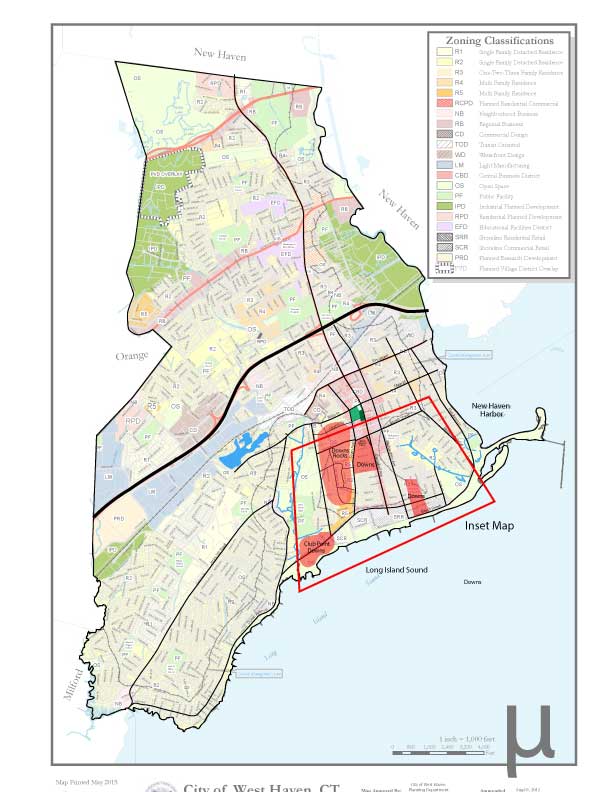 John Downs, at separate times, came into possession of 24 acres of land – the Downs Farm – in the area south of the West Haven Green. The property was bordered on the west by Savin Avenue and on the east by a line close to Campbell Avenue. The eastern boundary was actually a “southeasterly line” occupied by the “John Downs Fence”, the northern point of which was on Brown Street 200 feet west of the Brown Street/Campbell Avenue intersection. That entire area is now developed as a densely spaced residential neighborhood. It was on the 24 acres that John had built the family’s homestead in about 1667, one of the earliest homes built in West Haven. Before the homes were built, the farmers would travel from their homes in and around the New Haven Green over to “West Farms”. In 1692 John bought an additional 7 acres east of today’s Savin Rock and about the same amount on what was called “Club Point”, now a part of Savin Rock.
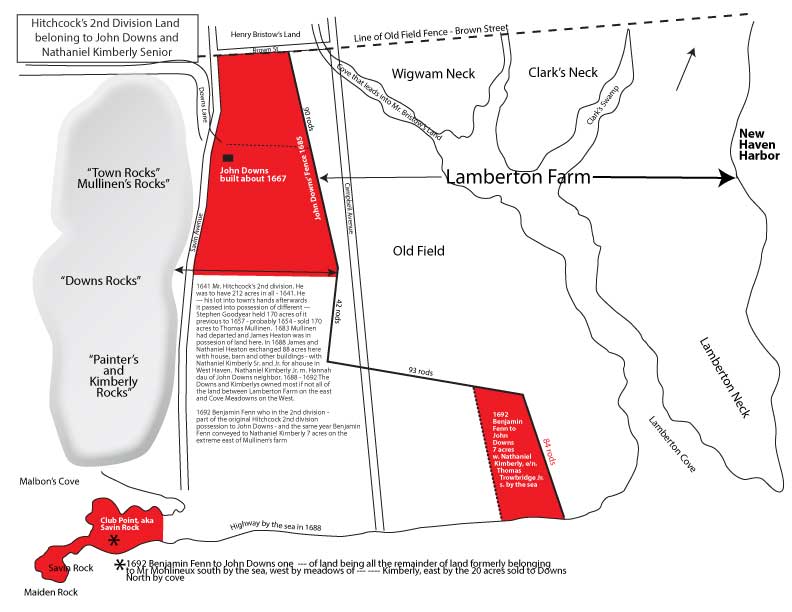 In 1685 or thereabouts, John Alling, Jeremiah Osborne and Abram Dickinson, on behalf of the Town of New Haven, sold 120 acres of land, commonly known as “Town Rocks” to Nathaniel Kimberly Senior, Nathaniel Kimberly Junior, Samuel Downs, Ebenezer Downs and John Mallory. That land (shown generally in gray on the accompanying inset map) exists today as neighborhoods on top of a rock outcropping extending from Main Street south almost to Long Island Sound. The land “together with all wood timber, trees, herbage and other appurtenances to the same belonging unto the said Town of New Haven and the inhabitants thereof, their heirs, successors or assigns, , persons all the stones in upon or belonging to the said parcel and every part of the said land with all needful ways to pass and repass for men, horses and carts and whatever else may be necessary for the digging, taking and transplanting of the same and also all such highways as may or shall be necessary for the proprietors of the adjacent meadow and pasture to pass and repass as occasion shall require, the land deeded to said Kimberly and Downs in equal parts to be divided as they see fit, and said Kimberly and Downs and the rest agree and provide to and with the Town of New Haven and the inhabitants of the same that for this time and all times hereafter to allow and — sufficient highways to such as may be — and necessary from the western part of said tract of land to the sea and also to the mouth of Malbons Cove and the meadows there for the carting of stones, hay and whatever else may be needful and also to provide and procure a highway as convenient as they can from the aforementioned Mullinen’s Rocks northward so as to meet with the highway [Main Street] that leadeth to Oyster Point.”
Because of all of this land ownership, the Downs and Kimberly Families owned most of the land between the “Old Field” – the Lamberton Farm – and Malbon’s Cove to the west of “The Rocks”, which also became known as the “Downs Rocks”.